Nobody’s Handed You a Manual for What Comes Next.
Lately I’ve been coaching a larger than average number of people who are figuring out how to manage up.
They don’t look alike on paper. There’s a scientist translating safety data for a room full of executives. One runs operations for a retail chain, adjusting to a new boss whose communication style is nothing like the bosses he’s worked with before. Another is a sales engineer working up the nerve to push back on a hostile VP. Don’t forget the a senior media executive learning to stay calm and unshaken when the pressure from above gets personal. And then there’s the military officer figuring out how to hold her ground with a commanding officer who criticizes her constantly.
Different worlds, same wall. Every one of them built real credibility doing the work a certain way, and now that approach isn’t working for the people above them. I love how the operations leader put it: “I used to show up and kick ass, and now I feel like I have to show up and kiss ass.” Is there a better way to say it? He’s holding himself to the same standard, but since the audience changed, he has to change his whole way of doing things.
I want to zoom in on one of these stories, because it shows the shift in slow motion.
This is Maya, a scientist. She spent years earning her seat at the table the same way most technical experts do. She knew more than almost anyone else in the room, and that knowledge was her passport. Ask her a hard question, and she’d have the answer. That was the deal.
But after a promotion, the deal changed. Suddenly she was in front of senior executives, and the thing that had always worked stopped working. Someone told her clearly: that’s not the currency here. From this point she didn’t know what her new passport was supposed to be. She just knew the old one had been taken away.
If you’ve spent your career becoming the expert, this may sound familiar.
The work nobody counts
Underneath every one of these stories is the same challenge: the constant, unsung calibration of which version of yourself a given setting needs. Do you lead with the data or the story? Do you go in with the recommendation or the options? Will your confidence be read as competence or overreach?
This came into the foreground for me when a participant in a conference breakout session last week said she’d always measured her own effort in physical terms, the things she had to get up and do. Anything psychological, anything emotional, didn’t register as real work in her own accounting. She’d feel guilty on the days that were actually the hardest because, by her own math, she hadn’t done anything.
This is known as invisible labor. None of it is written down anywhere. It produces no deliverable. So even the people doing it don’t count it as real work. It’s exhausting in a way that has nothing to do with hours worked.
What it looks like when it actually works
Adapting how you communicate to executives isn’t selling out. It’s a learnable skill. I teach a simple framework for it called VCN: Validate, Contextualize, and Negotiate. (You can get into the details here.)
Raj is another client, and he had spent months losing ground with a particularly tough, opinionated stakeholder. He told me his instinct, every time, was to go deeper into the technical explanation. Explain it better. Add more detail. But it never worked. The stakeholder dug in harder every time.
One day Raj tried something different, and it maps onto three repeatable moves.
He started by validating the request instead of arguing with it. The stakeholder wanted a closed case reopened because something new had come up. Instead of pushing back, Raj acknowledged that head-on: the customer had already acted, and something genuinely new had surfaced. He explicitly shared that reality with his stakeholder before saying anything else.
Then he contextualized the standard that actually had to remain. This needed to be treated as a new case, not a reopened one. That distinction wasn’t negotiable, and he said so plainly.
Once he was clear on what couldn’t change, something else opened up: what he was willing to change. That negotiation happened with himself, before it ever reached the stakeholder. He let go of the fifteen minutes of engineering detail he’d kept reaching for out of habit, the thing that had never once worked. What he picked up instead was a harder discipline: stay with what the customer would actually experience, and leave room for the stakeholder’s own read on it, instead of insisting on Raj’s. When Raj was done, the stakeholder’s whole posture shifted. “I see what you’re saying.” For the first time, they left the room agreeing on something, instead of each one convinced the other was being unreasonable.
The standard never moved. What Raj let go of was his attachment to explaining it his way, and that’s what turned a standoff into a conversation.
Making it power-aware
Raj’s version of VCN worked because he was managing up, toward someone with more positional power than he had. That direction matters. The same three moves look different when you’re managing down instead, toward someone with less power than you.
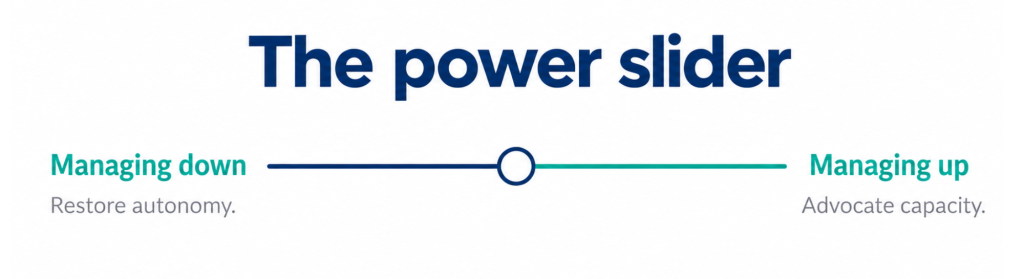
Picture it as a slider, not a switch.
On one end, you’re managing down, and the emphasis shifts toward restoring someone else’s autonomy. On the other, you’re managing up, and the emphasis shifts toward protecting your team’s capacity and the mission’s integrity. Same protocol, different weight on which move carries the conversation. Most days, you’re somewhere in the middle, adjusting in real time.
The standard stays fixed. The delivery adapts, depending on which direction you’re navigating. Raj’s stakeholder didn’t get a softer engineer. He got the same engineer, communicating in a way that finally worked.
No passport
Maya still hasn’t found her new passport, and that’s fine. She isn’t going to find it by studying harder or knowing more; she already knows plenty. What she’s building instead is the same three-move calibration that Raj found his way into: validate what his listener actually needs, hold the standard that isn’t up for debate, and negotiate with herself over what to let go of and what to articulate.
That’s not a lesser skill than expertise. It’s just one that few people get taught on the way up, even when it’s needed.