Among senior leaders, disappointment is rarely just an emotion; it is a disruption. Whether it is a missed quarterly target, a rejected strategic initiative, or a key hire who didn’t work out, setbacks are the background radiation of leadership.
The conventional wisdom suggests we should “look on the bright side” or treat these failures as “gifts.” But for a senior leader facing a high-stakes crisis, this advice can feel dismissive. You don’t need to pretend a crisis is a gift. You need to know how to lead through it.
The difference between leaders who spiral and leaders who adapt isn’t optimism; it is Cognitive Agility.
Psychological research tells us that when we face a significant setback, our brains often default to a “Threat State.” The amygdala hijacks our processing power, tunnel vision sets in, and our ability to think strategically creates a bottleneck. To clear that bottleneck, we don’t need a mantra. We need a protocol.
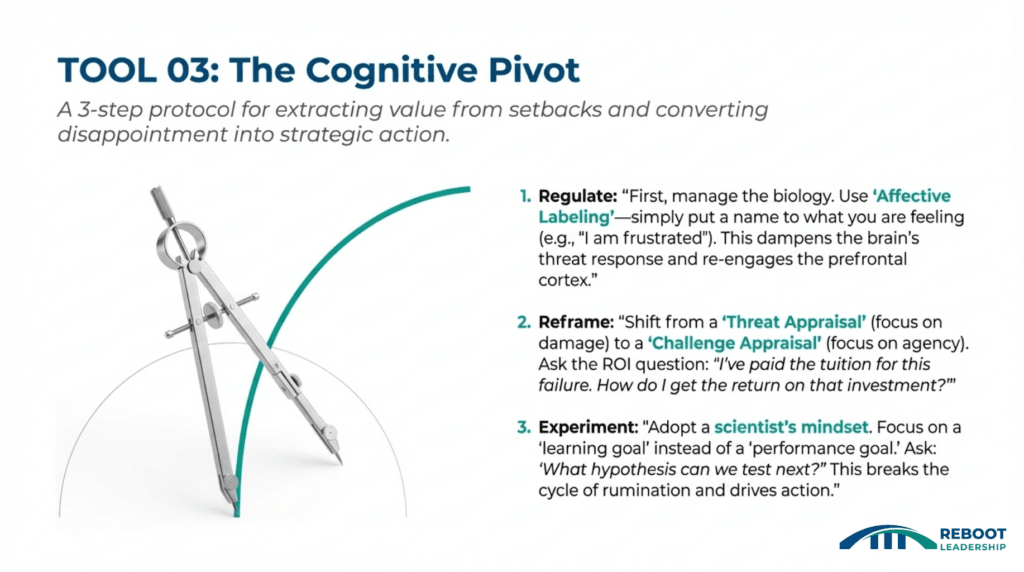
We call this protocol The Cognitive Pivot. It consists of three steps: Regulate, Reframe, and Experiment.
1. Regulate: Label the Data
The first step in recovering from a setback is biological. When you are disappointed, your body floods with cortisol. Your instinct might be to suppress the feeling and “push through,” but neuroscience suggests the opposite.
Research by Dr. Matthew Lieberman shows that “Affective Labeling”—simply putting a name to what you are feeling—dampens the brain’s emotional centers and re-engages the prefrontal cortex (the executive center responsible for planning and logic).
The Practice: Pause. Acknowledge the reality without judgment. “I am feeling frustrated because this delays our launch by two months.” You are not wallowing; you are labeling the data point so your brain can stop treating it like a saber-toothed tiger and start treating it like a logistics problem.
2. Reframe: Shift from Threat to Challenge
Once you have regulated the emotion, you must shift your appraisal of the situation. This is not about lying to yourself (“This disaster is actually wonderful!”). It is about shifting your focus from what you lost to what you can control.
In psychology, this is the shift from a Threat Appraisal (focus on damage) to a Challenge Appraisal (focus on agency).
The Practice: Ask yourself the ROI question: “I have already paid the ‘tuition’ for this failure. How do I get the return on that investment?”
Consider the “Sunk Cost” perspective. The failure has happened. That cost is gone. If you view the situation purely as a loss, you gain nothing. If you view the situation as a stress test of your current systems, you have data you didn’t have yesterday. That data is your ROI.
3. Experiment: The Bias for Action
Rumination is the enemy of recovery. The fastest way to break a cycle of disappointment is to engage in Learning Goal Orientation.
When we focus on performance goals (looking smart), failure is devastating. When we focus on learning goals (getting smarter), failure is just research.
The Practice: Adopt the scientist’s mindset. Instead of asking, “How do I fix this immediately?”, ask, “What hypothesis can we test next?”
I recently coached a VP whose team failed to get buy-in for a new customer experience metric. She was crushed. We used the Cognitive Pivot.
Regulate: She acknowledged she felt embarrassed and worried about her reputation.
Reframe: She stopped viewing it as a rejection of her and viewed it as data regarding the organization’s readiness for change.
Experiment: She hypothesized, “If I present the metric as a pilot program rather than a permanent change, resistance will drop.” She tested it. It worked.
The Bottom Line
Resilience is not about being impervious to disappointment. It is about reducing the “refractory period”—the time it takes you to bounce back.
By regulating your biology, reframing the threat as a challenge, and treating your next move as an experiment, you convert the raw energy of disappointment into the fuel for your next strategic win.
Coaching: The Catalyst for Agility
Cognitive agility is a skill, and like any skill, it requires reps. As an ICF-certified executive coach, I help senior leaders move past the theory of resilience and build the behavioral habits that sustain high performance under pressure.
If you are looking to sharpen your leadership edge, let’s have a conversation about how we can build your capacity to pivot.

Pingback: The Physics of Burnout: Why “Efficiency” is Costing You Your Best Decisions - Amy Kay Watson
Pingback: The Solitary Executive: Why Strategic Support is an Operational Necessity - Amy Kay Watson
Pingback: The Architecture of Repair: A 5-Step Protocol to Operationalize Conflict Resolution - Amy Kay Watson
Pingback: The Confidence Trap: Why Smart Leaders Leverage Strategic Doubt - Amy Kay Watson