In high-pressure environments, we often view resilience as the ability to endure pain. We treat our energy like a credit card with no limit, spending wildly on crises and ignoring the mounting interest rates.
But biologically, resilience is not about endurance; it is about recovery.
As a coach for senior leaders, I see brilliant professionals hit a wall—not because they lack skill, but because they are scientifically illiterate about their own biology. They view their exhaustion as a character flaw. In reality, it is a predictable result of the Conservation of Resources (COR) Theory: when your cognitive resources are depleted, your brain shifts from “innovation mode” to “survival mode.”
If you want to maintain high performance without burning out, you don’t need a vacation; you need a protocol. Here are three evidence-based strategies to regulate your biology and restore your leadership capacity.
1. Regulate, Don’t Criticize (The Science of Self-Compassion)
When you make a mistake or miss a deadline, your default setting is likely self-criticism. You might tell yourself, “I need to work harder,” or “I can’t believe I missed that.”
While this feels like accountability, neurobiologically, it is sabotage. Self-criticism activates your brain’s Threat System, flooding your body with cortisol and inhibiting your prefrontal cortex, the very part of your brain you need for strategic problem-solving. You are literally yelling at your brain while asking it to do complex math.
The Protocol: Adopt the approach of Dr. Kristin Neff and Paul Gilbert. Instead of beating yourself up, activate your Soothing System.
- The Shift: When stress spikes, pause. Acknowledge the difficulty: “This is a high-stress moment.”
- The Action: Talk to yourself as you would a trusted colleague. “Okay, the data is bad. Beating myself up won’t fix it. What is the first logical step to correct this?” This isn’t “being soft.” It is a rapid emotional regulation strategy that lowers cortisol and brings your executive function back online.
2. Stop the “Loss Spiral” (The Science of Boundaries)
Dr. Stevan Hobfoll’s research tells us that resource loss is far more psychologically impactful than resource gain. When you are depleted, you naturally become defensive, risk-averse, and reactive. This is called a “Loss Spiral.”
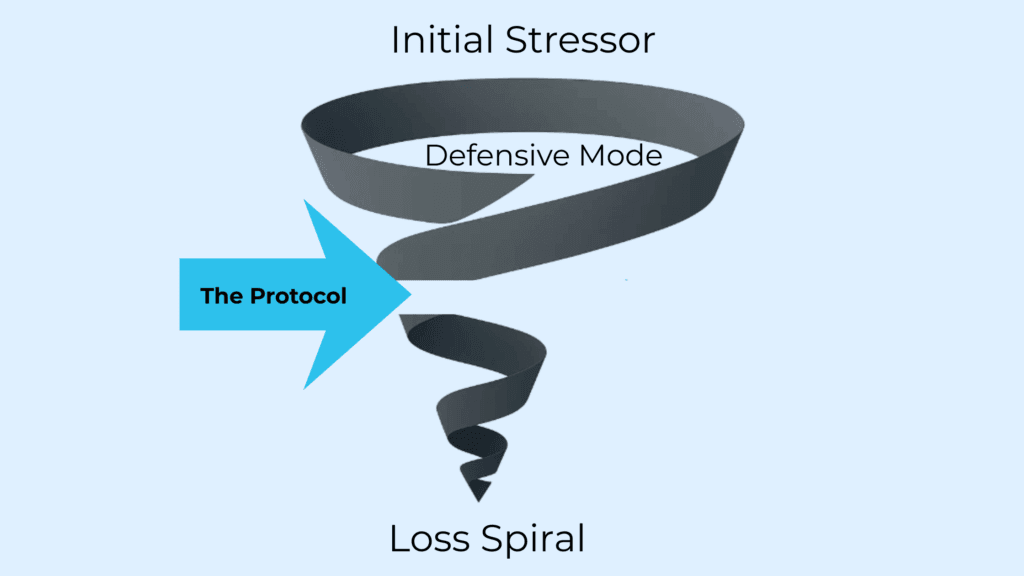
Many leaders accelerate this spiral by saying “yes” to low-value requests out of a desire to be helpful or liked.
The Protocol: Treat your cognitive attention as your organization’s most expensive asset.
- The Audit: Identify tasks that are “high-effort, low-impact.” These are resource leaks.
- The Script: For the “Diplomat” who fears saying no, try this: “I want to ensure I give this project the attention it deserves. Right now, my bandwidth is committed to [Strategic Goal X]. If I take this on, the quality of both will suffer. Can we delegate this to [Name], or revisit it next quarter?”
3. Distinguish “Numbing” from “Recovery” (The Science of Detachment)
When you are exhausted, it is tempting to collapse on the couch and scroll through social media. You feel like you are resting, but 30 minutes later, you feel no better.
Organizational psychologist Sabine Sonnentag distinguishes between Psychological Detachment (true recovery) and Passive Coping (numbing).
- Numbing (The 10th Truffle): As Brené Brown notes, the first truffle tastes good; the tenth is just an attempt to avoid feeling. Mindless scrolling or binge-watching prevents your brain from processing the day. It presses “pause,” not “reset.”
- Active Recovery: True recovery often requires effort. It involves mastery experiences—cooking, hiking, learning a language—that require full attention but use a different part of your brain than your work does.
The Protocol: Audit your downtime. If you finish an activity and feel more tired or mentally foggy, that was numbing. If you feel a sense of renewed energy or “freshness,” that was recovery.
- Try: A “Digital Sabbath.” Disconnect completely for a set window. This forces your brain to engage with the physical world, facilitating true psychological detachment.
The Leadership ROI
Ignoring these practices isn’t a badge of honor; it is negligence of your primary instrument: your own mind.
By regulating your threat response, protecting your cognitive resources, and engaging in active recovery, you aren’t just “being kind to yourself.” You are securing the asset that your team relies on.