I spent several years of my career facilitating Senn Delaney culture-shaping sessions, first for The Ohio State University, and then for Hertz Global Holdings. Senn Delaney, since acquired by Heidrick & Struggles, was the firm that effectively invented corporate culture shaping.
If you’ve attended a similar session, you’ve seen the Accountability Ladder:
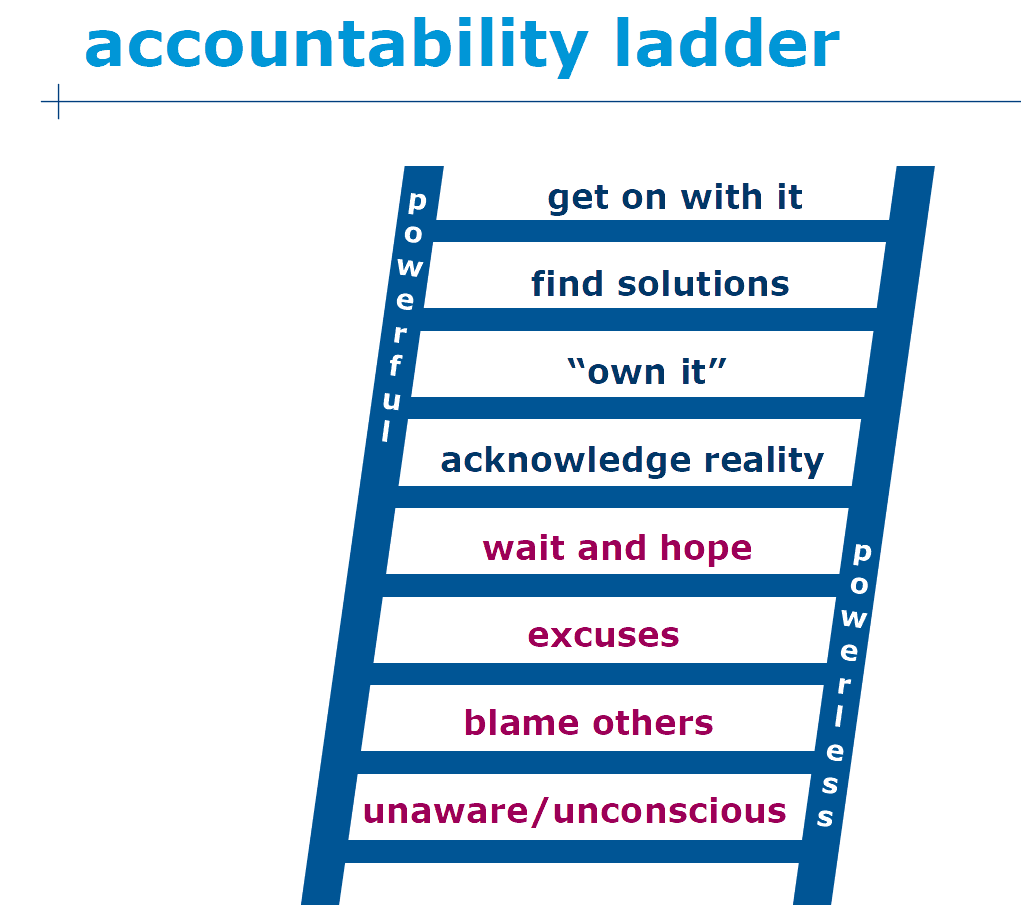
The concept can be powerful. It gives leaders a shared language to stop complaining and start solving. I believed in it then, and I still believe in the core principle today: We have more power over our results than we think.
Despite my belief in the model, after a decade of coaching and seeing this tool released “into the wild,” I noticed a disturbing pattern: The tool wasn’t being used to empower people. Too often it was being used to shame them.
I watched managers walk out of my workshops and immediately weaponize the language against their teams. “Kamil, you’re being a victim,” or “The back office is operating Below the Line today.”
Instead of inspiring ownership, the ladder was triggering silence and defensiveness.
The model wasn’t wrong, but our understanding of the human brain has evolved since the 1990s. We now know that “Below the Line” behavior isn’t usually a character flaw; it’s a biological reaction to a broken system.
If you want true ownership in your organization, we need to upgrade the operating system. It’s time to stop demanding “accountability” and start engineering Agency.
The “Shame Ladder” Backfires
The fatal flaw of the traditional Accountability Ladder is that it ignores the Fundamental Attribution Error.
This is a well-documented psychological bias where we attribute our own failures to the situation (“I missed the deadline because the server was down”), but we attribute other people’s failures to their character (“They missed the deadline because they are uncommitted”).
The moment a leader uses this model to label a team member, telling them they are “playing the victim” or “being defensive,” the psychological safety in the room evaporates.
The employee’s brain registers a threat. Their amygdala (the brain’s threat detection center) fires. Ironically, by verbalizing this judgment, you are chemically pushing your team further “Below the Line” into self-protection.
You cannot shame someone into ownership. Many have tried. It doesn’t work. To move beyond this defensive loop, we must look at the model differently.
The Upgrade: From “Trait” to “Signal Strength”
In the early days of culture work, we treated accountability as a character trait: you either had it, or you didn’t.
But modern cognitive science suggests we should view it as a State of Agency.
Agency, the capacity to influence your reality, is biologically expensive. It requires “System 2” thinking (Executive Function), which burns glucose and requires psychological safety.
You can think of Agency not like a ladder, but like the Signal Strength on a cell phone.
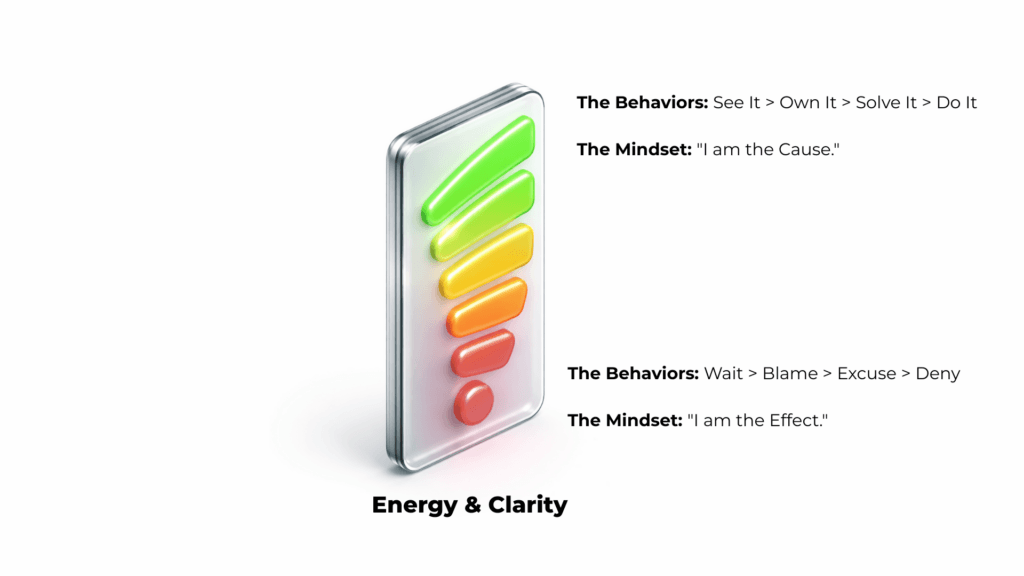
- Full Bars (High Agency): You are connected. You are generating solutions fast. You feel safe enough to say, “I own this.”
- 1 Bar (Low Agency): You are buffering, frozen. You are disconnected. You resort to “Waiting” and “Blaming” not because you are toxic, but because you are in low-power mode.
We all fluctuate. When I am well-rested and clear on my goals, I have Full Bars. But if I walk into a toxic meeting or face a roadblock that threatens my livelihood, my signal drops. That isn’t a lack of integrity; it’s physics.
How to Fix the Signal (The New Rules)
We don’t need to throw out the Accountability Ladder. We just need to change the user manual. Here are the two rules I now use to ensure this tool builds power rather than destroying trust.
Rule #1: The Mirror, Not the Window
The most common mistake I see leaders make is using the Accountability tool as a Window, a lens to look at their team and judge them.
To work, this tool must be a Mirror only. It is exclusively for self-diagnosis.
- The Mirror Check: “My signal is low right now. I find myself blaming the client. What do I need to do to get myself back to Full Bars?”
If you use this model to diagnose your team, you are judging. If you use it to diagnose yourself, you are leading.
Rule #2: Map the “Dead Zones”
If your cell phone drops calls every time you enter the basement, you don’t yell at the phone. (Or, if you do, you don’t seriously expect it to change because you yelled at it!) Rationally you recognize that you can’t get a signal in the basement.
In every organization I coach, I help the team find their Dead Zones: specific meetings, processes, or times of day where everyone’s signal drops. Take, for instance, these common organizational traps:
- The Monday morning budget meeting.
- The confusing travel expense software.
- The “Friday at 4 PM” panic email.
These are systemic barriers that force capable people into “Waiting” and “Blaming.”
Instead of asking, “Who is to blame for this delay?” gather your team and ask: “Where does our signal drop?”
Once you identify a Dead Zone (like The Friday Panic Email), you can do something akin to installing a Signal Booster: a specific team protocol to handle that stressor without losing Agency. (e.g., “Rule: No Reply-Alls after 3 PM on Friday. We make phone calls instead to cut through the miscommunication.”)
The Bottom Line
True accountability isn’t about taking the blame when things go wrong. It is about having the Agency to solve problems without fear.
The next time you see a team member “Below the Line,” resist the urge to correct them like we did in the old days. Instead, assume their battery is low or they are standing in a Dead Zone.
Don’t demand the signal. Improve the coverage.
The “Mirror Check” Toolkit: How to Read Your Own Data
When you look in the mirror and realize your Signal is low (you are in “Wait/Blame” mode), you need a way to reset.
You can’t just “decide” to have high agency if your brain is flooded with cortisol. You have to cool down the system first.
Senn Delaney taught a specific tool called The Mood Elevator that I still find value in to diagnose exactly where I am emotionally before I try to solve a problem. If I’m feeling judgmental or defensive, I know I have zero Agency. I have to get back to Curious before I can get back to Ownership. Read: How Emotional Self-Awareness and the Mood Elevator Transformed My Career
Take the Effective Performance Management Triage Assessment.
Pingback: How Emotional Self-Awareness and the Mood Elevator Transformed My Career - Amy Kay Watson