
In our current climate, polarization doesn’t stop at the office door. It follows us home.
I recently worked with a client, a high-performing executive, who found herself unable to concentrate on a critical Q4 objective. The distraction wasn’t a market shift or a competitor; it was the dread of an upcoming holiday gathering. The political and social divides that have fractured our society had fractured her family, and she was carrying the weight of that tension into every meeting.
We often try to compartmentalize leadership, treating it as a “work-only” skill. But the psychological reality is that how you show up at the holiday table is often exactly how you show up in the boardroom.
The family unit is the original organization. It is the system where our reactive patterns were formed. If you can learn to navigate polarization there, without cutting people off and without losing yourself, you can lead through anything.
The Science of the Anxious System
Murray Bowen, the psychiatrist who pioneered Family Systems Theory, identified that in any anxious system, family or corporate, the pressure for “togetherness” becomes overwhelming. The group subconsciously demands that everyone think and feel the same way to reduce the tension.
When you head home for the holidays, you are walking into a system that has decades of practice in pushing your buttons. If you express a differing view (on politics, health, or lifestyle), the system often reacts with what Bowen called “Sabotage:” subtle or overt pressure to get you back in line.
The leadership challenge is the same at the dinner table as it is in the C-Suite: How do you stay connected to the group without getting hijacked by the group’s anxiety?
The Practice: Self-Differentiation
Most of us default to two reactive strategies when family tension spikes:
Attack: We argue, try to convince, or dominate the conversation.
Withdraw: We go silent, check our phones, or cut off the relationship entirely.
Neither is leadership. Leadership is Self-Differentiation.
Differentiation is the ability to be a “separate self” while remaining emotionally connected to others. It is the capacity to say, “I love you, I disagree with you, and I am staying right here.”
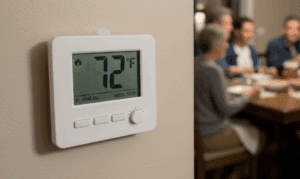
Think of it this way: An undifferentiated leader acts like a thermometer; their internal temperature rises and falls with the anxiety of the room. A differentiated leader acts like a thermostat; they set a temperature and hold it, eventually calming the system around them.
Your Holiday Leadership Protocol
Use your next family gathering as a “Leadership Lab” to practice these three steps.
1. Define Your “I” Position (Before You Arrive) Anxiety spikes when we are reactive. Preparation is the antidote. Know where you stand on the hot-button issues, and decide how much you are willing to engage.
The Goal: To be able to state your belief without needing to convince anyone else that you are right.
2. Expect the “Sabotage” When you stay calm in an anxious system, the system will try to rattle you. This isn’t personal; it’s mechanical. Expect the passive-aggressive comment or the guilt trip.
The Reframing: Instead of reacting, get curious. “Isn’t that interesting? The system is anxious because I’m not playing my usual role.”
3. Stay Connected (The Black Belt Move) This is the hardest part. It is easy to hold your boundaries if you leave the room. It is easy to stay in the room if you fold on your boundaries.
The Challenge: Can you listen to a family member express a view you find abhorrent, and respond with, “I can see you feel strongly about that,” without attacking or agreeing?
The Professional Payoff
Why does this matter for your career? Because the “muscle” you use to tolerate emotional discomfort at home is the exact same muscle you use to navigate a merger, a layoff, or a strategic pivot.
If you can maintain your presence and integrity when your family system is polarized, the boardroom will feel like a walk in the park.